
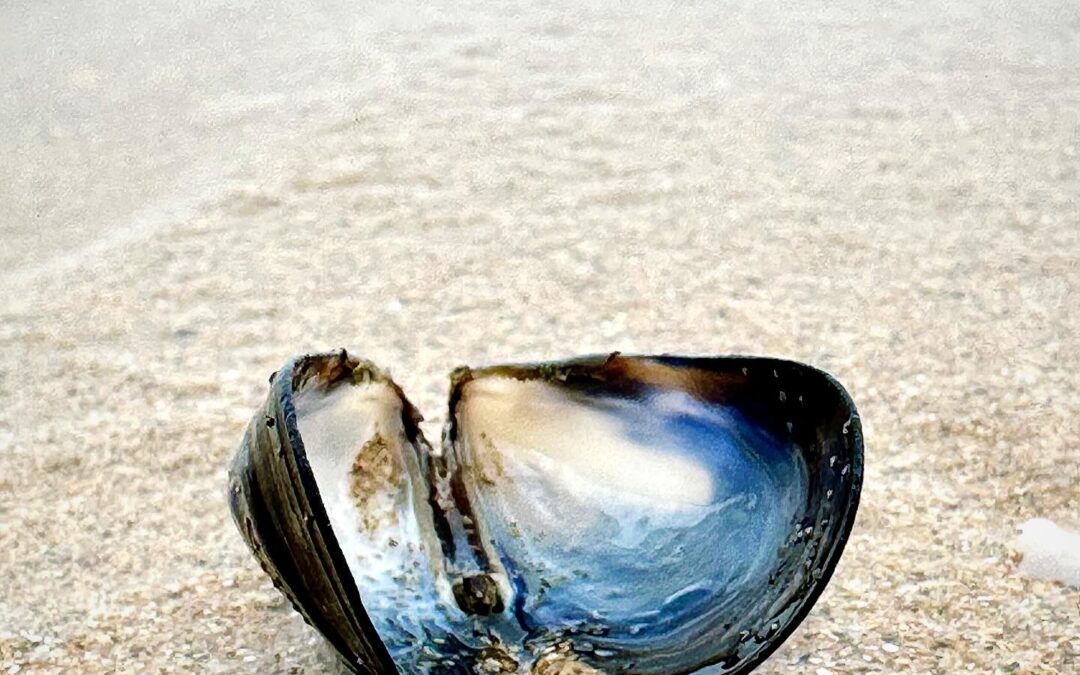
Wandering along the beach, a bracing wind blowing spray in my face, I noticed this beautiful mussel shell sitting empty and alone. As with many of the stray artefacts I encounter, I picked it up. Perhaps to decide if it should spend a while in my pocket, perhaps just to simply observe and return?
I enjoyed investigating the intricacies of its surface pattern, its shape and varied colours. The iridescent blues and purples, the pearlescent whites, and how it seemed to glow in my hand. I held it gently, feeling its weight and texture. I put it in my pocket for a while…
On my journey home, I began to wonder about this beautiful shell. Where had it come from? What might have eaten its fleshy insides?
A little research later I found myself more educated in the world of mussels...
Seabirds such as oystercatchers, cormorants and gulls feed on mussels. Not a huge surprise, but so do plenty of other sea creatures. Shore crabs, green crabs, fish such as flounder and whelk and even the common starfish all enjoy this protein packed meal.
Marine mussels reproduce by releasing their eggs and sperm into the water, where fertilisation occurs. The young begin life as floating plankton before attaching themselves to rocks where they grow into adult mussels. They can live for several years and their age can be estimated by studying growth rings on their shells, similar to counting tree rings.
Common mussels feed by filtering microscopic particles, algae, and plankton from the water and therefore play a crucial role in maintaining water quality.
Allowing ourselves the time to stop and be curious is hugely important, it's a habit many of us have lost. Curiosity is how we learn and make sense of the world around us, small children do it all the time. Slowing down to notice and taking time to learn not only rebuilds our connection with the natural world but is great for our mental health too.